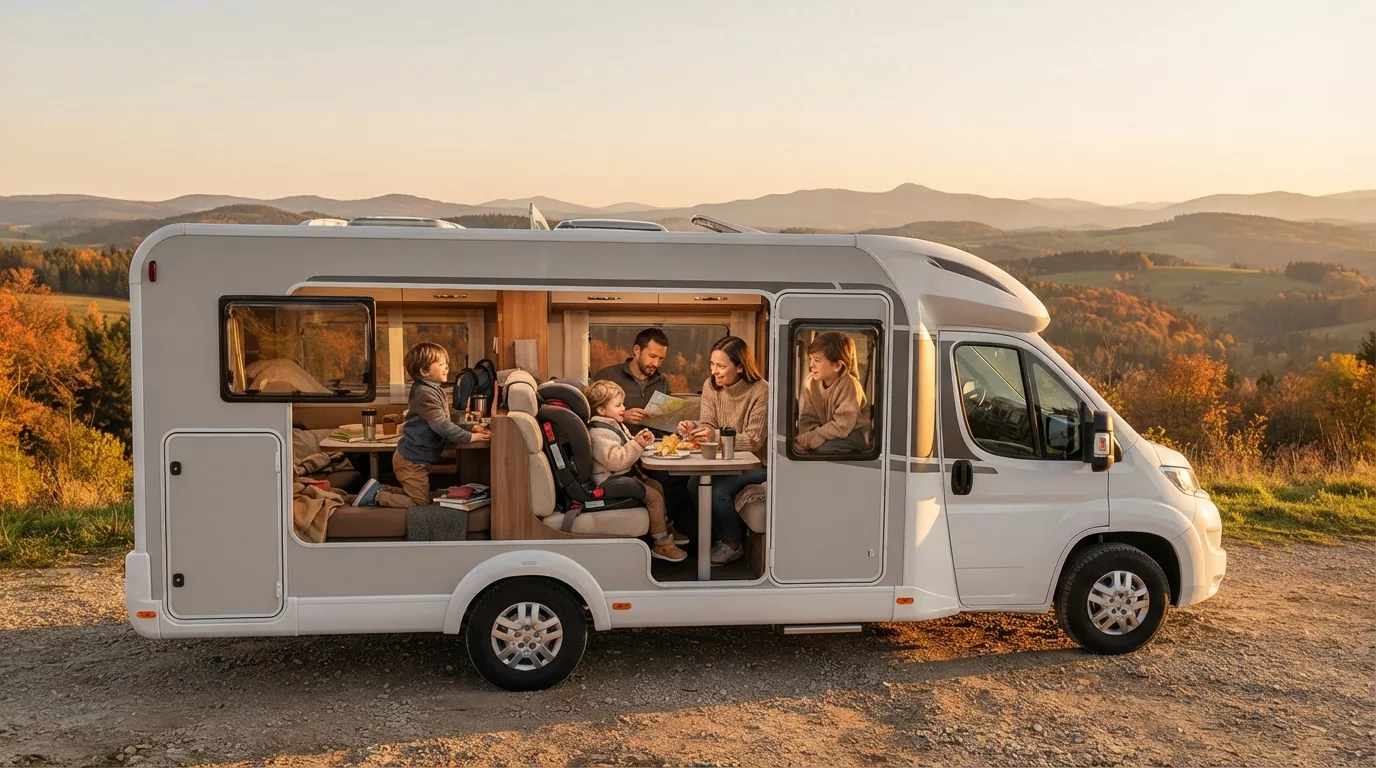
Traveling by Camper: Safety First
The charm of a camper is undeniable: the freedom to move, the possibility to discover new places, and the convenience of having your home on wheels. Whether you are a couple seeking adventure, a group of friends, or a family, the absolute priority when traveling in your vehicle must always be safety. This applies to driving, vehicle maintenance, and, of course, to the protection of all passengers while on the move.
One of the most debated aspects, and often a source of doubt, concerns the correct use of seatbelts and child restraint systems. It's not always clear what the rules are and how to apply them in a recreational vehicle. Let's clarify to ensure peaceful and compliant journeys.
Camper Seatbelts: Obligations and Advice
Italian law, in line with European regulations, mandates the use of seatbelts for all vehicle passengers, including campers. The law is clear: anyone occupying a seat equipped with a seatbelt is obliged to fasten it. This applies to the driver and all passengers, regardless of their position inside the camper (front or rear seats).
The issue arises when discussing rear seats, often located in the dinette or other areas of the vehicle not directly connected to the driver's cabin. Many campers, especially older models or those with certain configurations, may not be equipped with seatbelts on all seats approved for travel.
What does the law say about seats without seatbelts?
The Italian Highway Code (Legislative Decree 30 April 1992, n. 285), Article 172, states:
- The obligation to use seatbelts for drivers and passengers of motor vehicles.
- Exemption from the obligation for those occupying rear seats without seatbelts, but only if the vehicle was approved before June 15, 1976 (the date when the obligation for rear seatbelts for new approvals came into force).
However, it is crucial to emphasize that most campers registered in recent decades are equipped with seatbelts on all seats approved for travel. If your camper was registered after that date, it is almost certain that every seat is equipped for seatbelt use. European regulations have standardized these requirements, making the presence of seatbelts on rear seats the norm for new vehicles.
Our advice is to always check your vehicle's approval and the presence of seatbelts on every seat used while driving. In case of doubt, it is always better to prioritize safety and limit the number of passengers to seats actually equipped with restraint systems. Traveling with people not secured by seatbelts, even if permitted by law for older vehicles, exposes them to enormous risks in case of an accident.
Child Seats in Campers: Regulations and Practical Solutions
When traveling with young children, safety becomes even more critical. The use of approved child seats is a legal requirement to ensure the protection of little ones in case of sudden braking or impacts.
What are the rules for child seats in campers?
Italian law (Art. 172 of the Highway Code) requires the use of child restraint systems (car seats, booster seats) appropriate for their weight and height, if they occupy seats equipped with seatbelts. This also applies inside the camper.
The main challenge in a camper is finding suitable places to install child seats. Many modern campers are equipped with rear seats approved for travel with three-point seatbelts, ideal for installing ISOFIX seats or those using the vehicle's belt. However, not all campers offer this configuration, especially those with opposing dinettes or benches.
Install ISOFIX seats in a camperISOFIX systems are the safest and easiest to install but require specific anchor points on the vehicle's seat. Not all campers are factory-equipped with ISOFIX anchors on the rear seats of the living area. It is important to verify the presence of these anchors and their correct approval for use in a recreational vehicle.
Some camper manufacturers offer the option to install approved rear seats with ISOFIX anchors as an option or upon request. If your camper does not have these systems, you will need to opt for child seats that are installed using the vehicle's seatbelt.
Child seats with seatbeltsIf your camper has rear seats with three-point seatbelts, you can install approved child seats that are secured using the belt itself. It is essential to strictly follow the instructions of the child seat and vehicle manufacturer for correct and safe installation. An improperly installed child seat can be ineffective or even dangerous.
Alternative Solutions and Practical Tips
For those traveling with young children, the choice of camper and its interior configuration become determining factors for safety. If you are purchasing a new vehicle or considering modifications, consider:
- Campers with rear seats approved for travel: prefer models that offer rear seats with three-point seatbelts, possibly with ISOFIX anchors.
- Check approval: ensure that the seats on which you intend to install child seats are actually approved for transporting people while driving and that the seatbelts are certified.
- Positioning: ideally, child seats should be installed in the rear seats. Avoid, if possible, installing them in the front seats facing backward, unless the passenger airbag can be deactivated (which is not always possible or recommended in campers).
- Installation test: before embarking on a long journey, test the installation of the child seat and ensure it is stable and secure.
To learn more about making camper travel smoother and safer for little ones, you can consult our article dedicated to the first camper trip with small children.
Camper Regulations: What to Know to Travel Legally
In addition to seatbelts and child seats, there are other regulations concerning the use of campers that are good to know to avoid unpleasant surprises. The subject is complex because a camper is simultaneously a vehicle and a dwelling.
Dimensions, Weight, and License
Regulations on weight and dimension limits are fundamental. A standard B license is sufficient to drive campers with a maximum authorized mass (MAM) up to 3,500 kg. For vehicles with a higher MAM, a C1 or C license is required.
It is important to know the unladen weight of your vehicle and its payload capacity to avoid exceeding the maximum permitted mass, which can lead to penalties and safety issues. For more details, we refer you to our guide on camper tolls, which also touches upon the dimensional limits that affect costs.
Stopping and Parking
Rules for stopping and parking campers are often a source of confusion. Generally, a camper is treated like a motorhome and can park in spaces permitted for cars, provided its dimensions allow it. However, camping (occupying public space with tables, chairs, hanging laundry) is prohibited outside designated areas.
Camper service areas are regulated at national and regional levels, but it is always good to inquire about the specifics of the location where you stop. To understand how to choose best, read our article on service areas vs campsites.
Specific Regulations: The Highway Code
The Italian Highway Code is the primary reference. Article 172, as seen, governs the use of safety devices. Other articles are relevant for driving and parking campers. It is always advisable to have a copy of the Highway Code or consult it online for clarification.
For an official consultation of the regulations, you can refer to the Normattiva website: www.normattiva.it.
Safety on the Move: Beyond Seatbelts
Camper safety is not limited to the correct use of seatbelts and child seats. While driving, it is essential that all furniture is closed, heavy objects are secured, and there are no items that could move in case of braking or cornering. Anything not secured can become a projectile.
Regularly check tire pressure, wear, and manufacturing date, which are crucial aspects for road safety. A useful article for this is how to check camper tires.
Also, remember the safety related to the onboard systems: gas, electricity, water. Periodic checks are essential. For more details, you can read our guide on gas and refrigerator safety in campers.
mitcamper Tip
Traveling by camper is an enriching and connecting experience. Sharing the road with people who have the same passion can make every trip even more special. On mitcamper, you can find travel companions with whom to exchange advice, experiences, and, why not, plan unexpected adventures, always respecting safety and regulations.