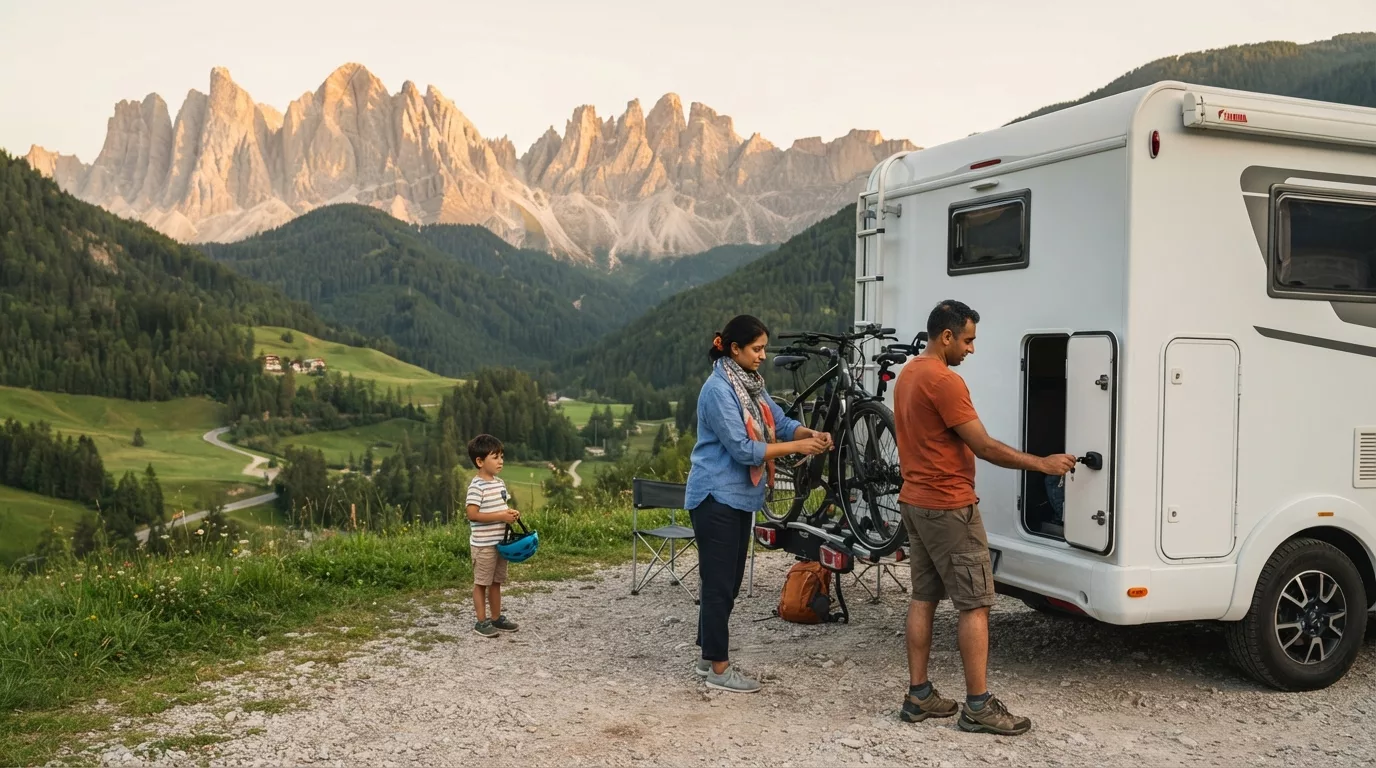
How do you handle: Bicycles and campers: a winning combination for road adventure?
Traveling by camper means freedom and flexibility. But what's better than combining this freedom with active exploration of the territory? Bicycles, for both adults and children, quickly become indispensable travel companions for those who love discovering hidden corners, enjoying breathtaking views, or simply taking a relaxing stroll after a day on the move. Whether you are a family seeking outdoor adventures, a couple eager to explore medieval villages, or a group of friends ready to cycle along scenic bike paths, two wheels add an extra dimension to the camper experience.
The ability to leave the camper in a strategic parking spot (like the German Stellplatz, French aire de service / aire camping-car, or Spanish áreas de servicio) and venture out by bike allows you to reach places otherwise inaccessible with the vehicle, move easily through historic centers, and fully enjoy the surrounding nature. But to do this safely and comfortably, the first question to ask is: how to transport bicycles with a camper?
How do you handle: Choosing the right bike rack for your camper?
The choice of bike rack is crucial and depends on several factors: the type of camper, the number and weight of bicycles, the budget, and personal preferences. There are mainly three types of bike racks for campers:
- Rear bike rack: This is the most common and versatile solution. It attaches to the rear wall of the camper and can be extendable to carry multiple bikes. It's important to check compatibility with your vehicle model and ensure that the total weight of the bikes does not exceed the maximum load capacity of the rack and the camper's wall. Some models are specific for overcab campers, others for low-profile or integrated motorhomes.
- Platform bike rack (or tow hitch rack): If your camper is equipped with a tow hitch, this can be an excellent option. Platforms are robust and facilitate loading and unloading of bicycles, even heavier electric ones. They often offer greater stability and security.
- Roof or garage bike rack: Some campers, especially those with a large rear garage, allow the installation of internal fixing systems for bicycles. This solution protects the bikes from the weather and theft but requires space and a bit more effort for loading/unloading. Roof racks are less common on campers due to height and weight, but specific solutions exist.
Practical tip: Before purchasing, always check the technical specifications of the bike rack, its maximum load capacity, the number of bikes it can carry, and its compatibility with your camper model. Do not underestimate the additional weight you will be carrying, especially on inclines or in windy conditions. For more on general vehicle safety, you can consult the safety category on our blog.
Bicycle transport: regulations and safety
When traveling with bicycles loaded on the back of the camper, it is essential to follow certain rules to ensure your safety and that of others. First and foremost, bicycles must never protrude beyond the vehicle's silhouette, nor obscure lights, indicators, or the license plate. In many European countries, it is mandatory to signal protruding loads with a reflective white and red panel, especially if the bikes extend beyond the vehicle's outline. Check the specific regulations of the country you are traveling in:
- Italy: The Highway Code provides specific regulations for transporting objects on the rear of the vehicle. Bicycles must not obstruct the visibility of the license plate and lights. If they protrude, the white-red panel is mandatory.
- Germany: Regulations are similar. Bicycles must not obscure the license plate, lights, and indicators. If they protrude, a special sign is required. For detailed information, the ADAC (German Automobile Club) website is a valuable resource: www.adac.de.
- France: Here too, safety is paramount. Bicycles must not extend beyond the vehicle's silhouette. If they do, a homologated reflective panel is mandatory. The Service-Public.fr website offers useful information: www.service-public.fr.
- Spain: Spanish regulations require that loads do not obstruct visibility. If bicycles protrude, a specific warning sign is necessary. The Dirección General de Tráfico (DGT) provides precise guidance: www.dgt.es.
Important: Ensure that the bicycles are securely fastened to the rack with sturdy straps to prevent dangerous movements while driving. Periodically check the fastenings, especially after driving on rough roads or in adverse weather conditions. For advice on handling difficult weather, read our article on extreme weather in a camper.
Cycling itineraries for camper families in Europe
Once the transport issue is resolved, the vast world of itineraries opens up. Europe offers countless opportunities for cycling explorations starting from your camper. Here are some ideas to inspire your next holiday:
Cycling routes in Italy
Italy is rich in routes suitable for all levels. From the rolling hills of Tuscany, perfect for tasting local wines and products, to routes along the northern lakes, such as Lake Garda or Lake Maggiore, ideal for outdoor days with the little ones. For sea lovers, the Adriatic coast offers cycle paths connecting seaside resorts and art cities. An example is the cycle route from Venice to Puglia, an unforgettable journey along the coast. For those seeking less-traveled paths, the slow Apennines offer trails immersed in nature, far from the summer crowds. If you are interested in specific itineraries, check out our suggestions on Italian lakes by camper or on a slow holiday in the Apennines.
Exploring France by bike
France boasts an extensive network of Voies Vertes (greenways) and Véloroutes (cycle routes), paths often built on disused railway lines or riverbanks, ensuring safe and scenic rides. The Loire Valley, with its fairytale castles, is a classic destination for families. Provence offers enchanting landscapes amidst lavender fields and picturesque villages. The Atlantic coast, with the Vélodyssée, is also a spectacular route crossing forests and dunes.
Cycling in Germany and Austria
Germany and Austria are leading countries in terms of cycling infrastructure. Along major rivers like the Danube (Donauradweg) or the Rhine, there are flat and well-signposted routes, ideal for those traveling with children. The Alpine regions offer more challenging but spectacular routes, with the possibility of using ski lifts to transport bikes uphill. The areas around the Bavarian lakes are perfect for more relaxed excursions.
Cycling adventures in Spain
Spain, although often associated with heat and beaches, offers surprising opportunities for cycle tourism. The Vías Verdes, similar to the French Voies Vertes, are a network of old railways transformed into cycle and pedestrian paths. Catalonia, Asturias, and the Murcia region offer diverse itineraries, from coasts to mountains. For nature lovers, Spanish natural parks are often crossed by bike-friendly trails.
Tips for cycling with children
Traveling with children by bike from your camper requires a few extra considerations:
- Safety first: Approved and properly fastened helmets are mandatory. Ensure children's bikes are the right size and in perfect condition. Consider using child seats or trailers for younger children if distances are short and the terrain is flat.
- Route selection: Prioritize dedicated cycle paths, low-traffic roads, or easy dirt tracks. Avoid busy roads and steep descents. Consult local guides or dedicated apps to find the most suitable routes. For those who enjoy light trekking, we've gathered some useful tips: light trekking with children.
- Pace and breaks: Adapt the pace to the children's. Plan frequent breaks for drinks, snacks, and rest. The holiday should be enjoyable for everyone, not a competition.
- Equipment: Always carry plenty of water, energy snacks, a first-aid kit, and basic tools for minor repairs. Don't forget sunscreen and a hat, even on cloudy days.
- Fun: Turn every ride into an adventure! Look for playgrounds along the route, stop to observe nature, collect interesting stones or leaves. The goal is to create positive memories associated with movement and discovery.
Beyond the ride: living the camper life with bicycles
Bicycles are not just a tool for exploration but also a way to make life on board more dynamic. You could use them to reach a nearby supermarket, do a quick grocery run, or simply take an evening ride around the campsite area. Remember to protect the bikes from the sun when parked on the rack, perhaps with special covers, and keep them clean to avoid bringing sand or mud inside the camper. For those traveling in sandy areas, we've gathered tips on how to manage sand in a camper.
Integrating bicycles into your camper holiday means adding a level of interaction with the places you visit, making every trip a richer and more personalized experience. Whether exploring the Dolomites by mountain bike or taking a relaxing stroll along an Italian lake, two wheels are a valuable accessory for every camper.
mitcamper tip
Traveling by camper is an enriching experience, especially when you have the opportunity to share special moments. If you are looking for travel companions to exchange tips, experiences, or simply chat over a coffee, mitcamper is the ideal platform to connect with other road life enthusiasts across Europe.